

Rail freight car fleet is depreciated by 90%. Instead of encouraging the construction of cars in Ukraine, the Cabinet of Ministers supports the purchase of Russian junk.
In 2018 alone, about 4 thousand freight cars that were written off and prohibited from using in Russia were imported to Ukraine.
All of them continue their lives on the railway of Ukraine. In the rail car manufacturing market, it is one of the taboo topics for public discussion.
In order to assess its significance and actual extent, let us look at the damage that these cars inflicted on the rail car manufacturing plants, their linked industries and the economy of Ukraine as a whole in 2018.
We have already raised this issue at the Rail Cargo Spring 2019 forum. The resonance caused by our report gives us hope that we will be heard.
The technical state of the car fleet of Ukraine
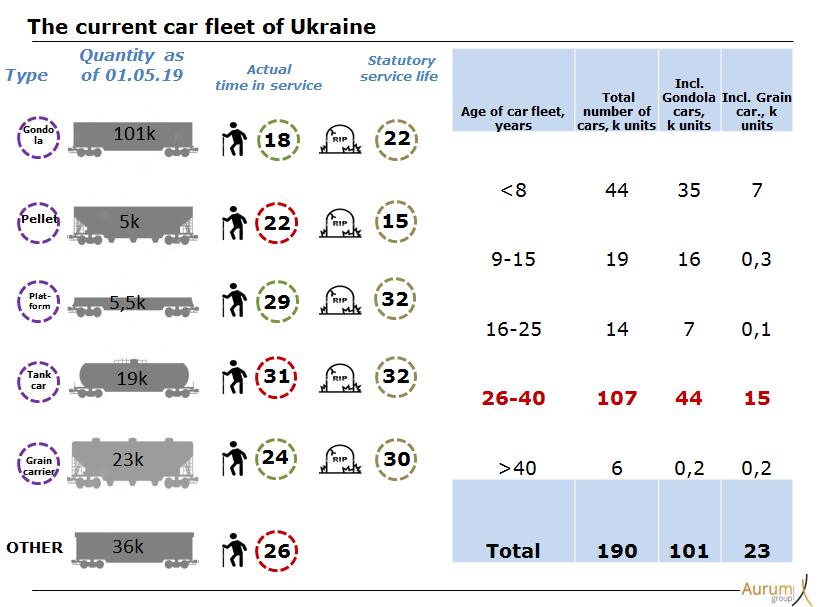
By 2018, the freight car fleet “Ukrzaliznytsia” (UZ) had been worn out by more than 90%. The situation improved slightly after its own production of 2.9 thousand cars in 2018 and purchases from rail car manufacturing plants.
In general, in 2018 in Ukraine, all participants of the rail car manufacturing market sold 8.5 thousand new gondola cars and 2.7 thousand new grain carriers, 3.5 thousand of which were commissioned by UZ. That means that during 2018, 11 thousand new freight cars were placed in service, which is a record number in the last five years.
However, things are looking grim.
On May 1, 2019, the total fleet of gondola cars of “Ukrzaliznytsia” and private owners was about 102 thousand cars, 44 thousand of which were 26-40 years old. According to the design documents, the service life of gondola cars is 22 years, that is, 48% of the fleet exceeded the admissible service life duration long ago.
The situation with grain carriers is at a critical juncture. Out of 23 thousand cars, 15 thousand are over 26 years old, which is 65% of the total number of grain carriers.
The age of the remaining fleet is also quite advanced. The average age of pellet cars is 22 years with a service limit of 15 years, tanks – 31 years with a maximum of 32 years, platforms – 29 years with 32 years of statutory service life.
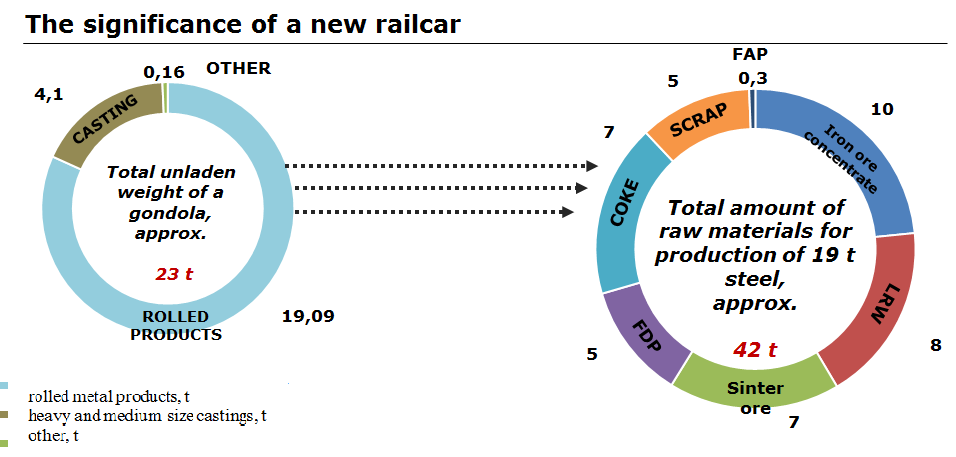
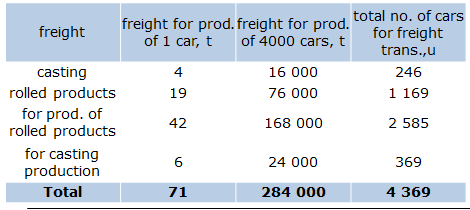
Simple calculations show how unprofitable for all market participants and for the country’s economy as a whole is the “procedure for extending the service life of cars”.
According to our estimates, the total amount of funds not invested in the domestic rail car manufacturing alone in 2018 was UAH 5 billion, and if to take related industries into account, the total money turnover might be about UAH 15 billion.
Meanwhile, over UAH 1.1 billion was invested in the purchase of Russian junk. We are investing in the development of rail car manufacturing of another country, destroying our own plants.
How to alter the situation
The Cabinet of Ministers and the Ministry of Infrastructure need to develop a target programme to update the state freight car fleet.
“Ukrzaliznytsia” and the Ministry of Infrastructure should review the procedure for extending the service life of cars. In particular, limit the service life of cars to the statutory period established by design documents and tighten control over the turnover of foreign operator cars.
It is important for the government and the Ministry of Infrastructure to think of limiting the import of old cars, and for national operators to think of increasing orders for the production of freight cars at domestic rail car manufacturing plants.
Banks should improve leasing conditions for national operators by reducing a down payment up to 20% and lowering the interest rate on leasing.